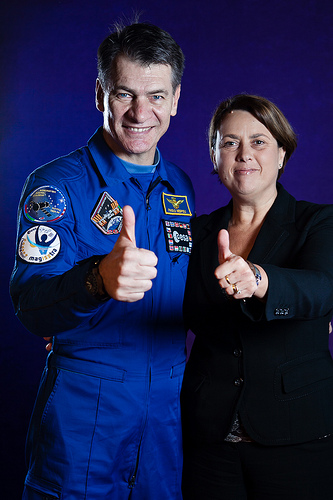
Simonetta di Pippo is an Italian astrophysicist who currently holds the role of Special Adviser to the Director General of the ESA — European Space Agency.
She is a woman with an impressive career to her name: for three years, from 2008 to 2011, she served as Director of Human Spaceflight at the Italian Space Agency; previously she worked on major international projects, including as ESA delegate to the ISS (International Space Station), European expert at NASA on the international Mars exploration programme, she contributed to the development of the Aurora programme for robotic solar system exploration, and in 2007 she was assigned responsibility for the mission of Italian astronaut Paolo Nespoli, aboard Space Shuttle flight STS-120 — which many of you will likely remember for his intense Twitter activity during his last mission.
Author of the book “Astronauti”, and always devoted to her work and mission with great passion, committed to the popularisation of space exploration, I had the extreme pleasure and honour of interviewing her for the readers of Tiragraffi, at the last edition of Frontiers of Interaction, trying to understand her point of view on women in the space sector and on Italy as a protagonist in space exploration.
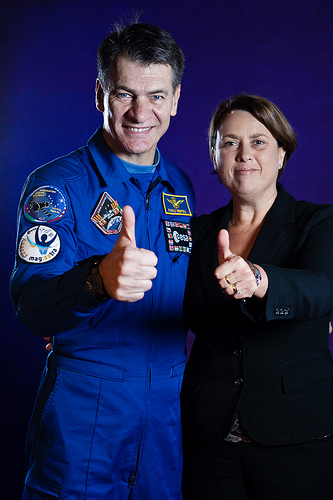 Simonetta di Pippo and Paolo Nespoli
In your life you have had an intense and glorious career. How and when did you decide to embark on this life and professional path? Was there a particular event that made you understand this was your road?
It is never easy to associate one particular event, a single event, with a life choice. Because working in this sector is a life choice. And it is also a choice driven by a passion for never ceasing to learn, in a continuous process of growth — above all personal growth — which is the great motivational force behind a career like mine. What I have always known, however, and which holds true in general, is that to achieve any result you must work hard, and as I love to say, always resist one minute longer than the others. This implies perseverance, attention to detail, precision, but at the same time creativity and flexibility. A cocktail of qualities and competences that can certainly be learned, but which must also be part of one’s DNA together with a massive dose of humility — without which one risks failing to see potential critical areas and putting in place the necessary remedies in time.
If, however, we wish to cite a particular event, I would refer to when I wrote my book “Astronauti”, published by Mursia in 2002, where I describe the evening of the first man on the Moon and how I experienced it, at the age of 10. If one event shaped my choices, it was almost certainly that one.
Few women are professionally involved in the space sector; Samantha Cristoforetti, for instance, is the only female European astronaut. What do you think the future holds in this respect? And what, instead, is your dream or wish?
For decades I resisted the temptation to consider gender discrimination as a determining factor in my career, despite being well aware that society is permeated by it. And certainly not only in Italy — the issue is far broader. The discrimination I have suffered, and continue to suffer, is often insidious and not apparent through glaring episodes, even if a couple of such episodes in my career have indeed been glaring. But this has not prevented me from doing what I wanted and needed to do — it has only made it more difficult for me, sometimes very difficult. A few months after my appointment as Director of Human Spaceflight at ESA in May 2008 — the first woman in history to be appointed a director at ESA since its founding in 1975 — I realised that the problem of women asserting themselves in the aerospace field, trying to circumscribe the issue even though we know the question is far broader, was not only Italian, and not only at the top levels. How many women in Italy have been appointed presidents of a research institution? Very few, and only very recently. And how many women have managed to be appointed Director General of ESA? None, in its 37 years of existence! The reason given is that there are no women of sufficient calibre; my conviction is that selection committees are almost always strongly male-dominated, and moreover the management style of women is different, sometimes very different, from that of men. So in 2009 I founded an international association, Women in Aerospace Europe, based in the Netherlands, with the aim, among others, of creating a global network of federated associations with WIA US (the founding chapter) and the newly established WIA Canada, WIA Africa and the nascent WIA Latin America. The association has many objectives, and one of the principal ones is to help young women believe they can achieve their dream and to guide them in their choices and professional growth. Since 2009, under my presidency, WIA Europe has made great strides — and I hope it will take many more soon — with a view also to establishing a systematic presence of women at the helm of companies, agencies and scientific councils. And putting an end to the “excuse” that is so often deployed, namely that women of sufficient calibre cannot be found!
Italy, as perhaps not many people know, has always been very important in the space sector; one need only think, for instance, of the recent VEGA launcher which is almost entirely Italian. How do you think Italy’s role will evolve in this respect?
Italy has always played a leading role, from the very beginning of the astronautical era. One need only think of the launch of San Marco in 1964, of the first non-Russian and non-American module temporarily docked to the International Space Station in 2001, of the first European astronaut on the ISS who was of Italian nationality — and I could go on. VEGA represents another important example, but within the European context, since it was developed under the ESA umbrella. How Italy’s role will evolve is a decision that rests with the Government, since Italy’s future role is intrinsically linked to choices of industrial policy, scientific policy, and to the recognition of space’s importance as a synonym for innovation and development. There is certainly also the question to be addressed, at least at the European level, of the governance of space activities, since the Lisbon Treaty assigns to the European Parliament the competence to define and manage European space policy, and the European Commission is currently working on the definition of the Horizon 2020 programme with a budget dedicated to space technologies for the first time in the history of the Union (if we exclude, obviously, the budgets dedicated to the Galileo and GMES programmes, for which ad hoc allocations were made).
Season all of this with the well-known issues linked to the current (hopefully temporary) economic difficulties, and we arrive at the conviction — the sooner the better — that this situation of what we might call stalemate will give way to the recognition that the first phase of the astronautical era has ended — an era whose beginning can be traced to Yuri Gagarin’s first flight in 1961 — and that a second is about to begin; one that will undoubtedly draw on the enormous progress made, above all in the USA, by companies approaching access to space commercially, currently “targeting” low Earth orbit (around 400 km altitude). In short, radical change is in store — a paradigm shift, one might say. And Italy has the technical capabilities to rise to the challenge, which will mark — together with other choices I hope the country will make in terms of research and innovation — the future of our young people.
And what could be done to more widely disseminate the culture of space exploration and raise awareness among Italian students — not only on this subject, but also on our country’s role?
Popularisation has always been, for me, an obsession. But it is one thing to have the awareness, the will, and the capacity to communicate, and quite another to have the time and energy to devote to it when you are managing major international programmes like the International Space Station or the Solar System exploration programmes. At a personal level, therefore, I have tried to dedicate myself to schools of every level, to university courses — above all Executive MBA programmes — combined with communication through the most common media, both the standard ones such as radio and television interviews and articles and interviews in newspapers and periodicals, and through 2.0 communication, for example via a Twitter account. I have also tried to blend different disciplines, with experiments such as combining space and music — hence my presence at the Teatro Carlo Felice in Genoa and my appearance on stage during a Pooh concert at the Teatro degli Arcimboldi in Milan, in order to speak about space to a more varied audience.
Certainly, in order to bring the public closer to space, it would be appropriate to introduce dedicated courses in schools, or even to fund scientific experiments devised by students and flown, for instance, on the ISS. This too would represent a paradigm shift in the way we do education — and I am referring to Italy in saying this. You cannot love what you do not know, and space, well taught, could draw young people to scientific disciplines at university, enabling a modern, innovation-oriented approach on the part of our young people — not necessarily in space itself, but more broadly on scientific subjects and disciplines of which there is great need in order to relaunch the country and its economy.