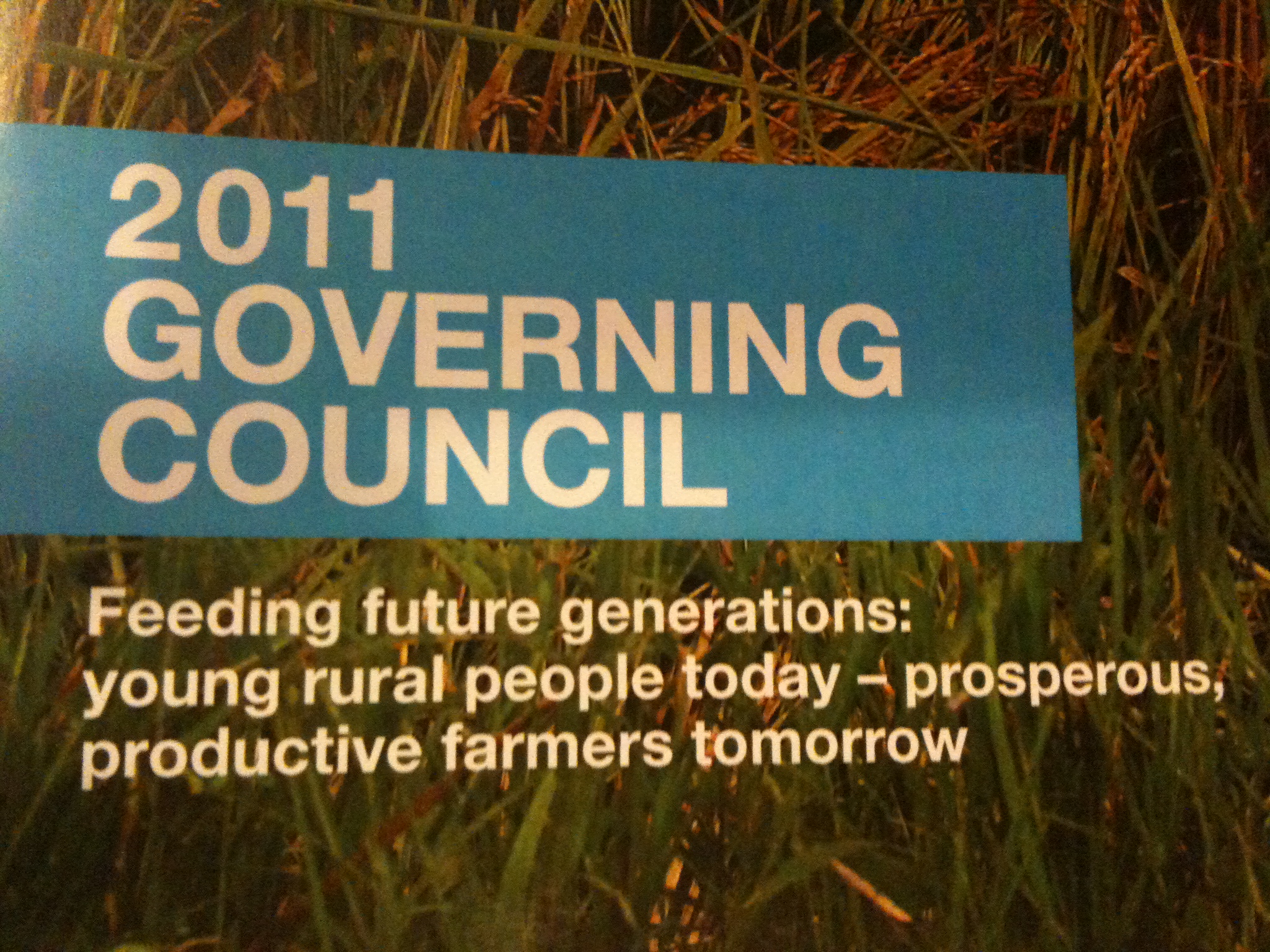
Last Saturday, 19 February, I had the opportunity — or rather, I would say the honour — of attending the 34th Governing Council of IFAD in Rome. The event brought together delegates from 167 IFAD member countries who, alongside international figures, young leaders from farming communities, and high-level institutional representatives, debated how to guarantee food security, strengthen smallholder farmers, and how to support — and above all encourage — young people living in rural areas of developing countries.
Opening the proceedings, Fund President Kanayo F. Nwanze said that IFAD is working to build stronger and more dynamic rural economies, which will in turn give momentum to the agency’s efforts to eradicate rural poverty. “The programmes and projects we support are creating the conditions for smallholder farmers and the entire rural poor to become small entrepreneurs in the new emerging markets.”
The Board of Governors was also attended by Kofi Annan, Chair of the Alliance for a Green Revolution in Africa (AGRA) and former Secretary-General of the United Nations, together with Princess Haya Al Hussein, UN Messenger of Peace, who touched on a fundamental point of discussion that was later taken up in the afternoon during a round table in plenary session: “making agriculture more attractive to young people with ambition and initiative.” “They are the generation needed for sustainable change to occur.”
This is a theme that has always been very close to my heart, one that touches me personally. For years I have followed and supported the Slow Food movement founded by Carlo Petrini, who was the protagonist of the round table held during the afternoon — a round table I was very happy to attend.
It was without doubt an incredible and moving experience. Seeing so many governors and high-level figures gathered together to discuss something as important as the development of agriculture gave me a measure of renewed hope for our planet.
Carlo Petrini’s remarks — which you can in some ways read summarised in this interview — were enlightening and charged with great emotion and passion.
According to Petrini, the classical approach of treating food as just another commodity like any other has been a failure.
“Agriculture needs a holistic approach, and young people must be put in a position where they want to stay and work the land.”
“You cannot talk about young people without young people,” he continued. “It should not be the governors discussing this, but the young farmers themselves!” In this way he urged government representatives to invite young people to future meetings, and offered Slow Food’s willingness to welcome them all.
He also stressed repeatedly the importance of the traditional knowledge of farming communities, which must be preserved and integrated with science. “We must build a dialectical relationship, a dialogue between science and traditional knowledge.”
In short, without a doubt an example of great hope and vision for the future in which the principal protagonists are precisely the young.
A special mention goes to the IFAD Social Reporting Team, who through Twitter and Facebook gave everyone, all over the world, the chance to follow and engage with the round table proceedings, moderated by former CNN journalist Tumi Makgabo.
A truly comprehensive and thorough live-blogging effort, to which I tried in my small way to contribute — and which, with great joy, made me feel a useful part of something.
I can only thank IFAD and the people who work there, whom I was able to meet that day, for the great and precious opportunity they gave me, and which I hope may be repeated in the future.