Here I am again with the rest of the travel diary I promised you. I know very well it is a very long post… but it is really worth taking a little time to read it in full. I didn’t have the heart to “break it up” further, and I didn’t want to interrupt the flow of events recounted here too much :)
I am finishing organising the photos they took to publish them, and I am also finishing editing the various videos they shot; some are truly wonderful.
I hope you find it an enjoyable read :)
Simona
Day 5 (Wednesday the 16th)
Definitely the most gruelling day!
Departure at the usual time, after breakfast. Destination Mogtedo to visit 4 villages; in order:
- Bomborè V6
- Rapadama V7
- Mancarga V5
- Bessin-Noghin
Bomborè V6
There is a market at Mogtedo.
Along the dirt track we turn onto, immediately on the left an endless stream of people on foot, on carts pulled by tired little donkeys, motorbikes and bicycles loaded to the absolute limit of anything your imagination can conjure up, and more.
Crates heaving with chickens, goats with all four legs tied in a bundle lying inside semi-cylindrical baskets, not exactly comfortable… All of it enveloped in a reddish dust cloud, stirred up by the wind from all this to-and-fro of people and engines.
The track does not take long to become a mere trace through the bush, which keeps crossing other trail traces, perpendicular, converging, oblique, diverging (which makes you wonder, why did Marcel take this one and not that one, or that other one…), and also parallel ones where it is necessary to go around the most uneven and water-eroded sections to cross the dried-up river beds.
We stop several times to ask for directions. We’ll spare you the rest and take you straight to the site, after two hours of driving from Koupela and some 40 kilometres of dirt tracks from Mogtedo! Will you let us be a little battered? (yes, but the best is yet to come…).
The well is one of those built about two years ago, perfectly functional, and serves a community of around 5,000 people (!), assisted by one other “colleague” located about 400 metres away.
It has an India pump; generally we are not entirely keen on these — we notoriously prefer the Volanta. But Barnabé explains the sound technical reason: where the ground is more friable the Volanta’s cylinder tends to wear out faster under the abrasive action of fine sand, which does not happen with the India pump (and after this erudite technical explanation, we keep to ourselves the emotions and feelings of contact with the local people, and above all… you know what).
Rapadama V7
We set off again. Rita moves along the seat towards me because the sun is beating on her side. We won’t linger on road conditions because by now nobody cares anymore. But along the edges we start to notice first scattered groups, then clusters of women (with children in tow) engaged in a strange occupation: they are digging holes in the arid ground, piling the excavated earth in small mounds along the edge of the hole. The surrounding terrain, among the bushes, is full of these powdery cones. In our best English, with Alexis who only speaks French, we ask for an explanation. Alexis makes a strange gesture, shows us his ring: “they find gold!”.
Yes, that is exactly it: they are gold seekers! And we will actually get to see it, for you sceptics who don’t believe us… We suddenly notice something strange: Massimo moves towards Rita to escape the direct sunlight. But… we are travelling in the opposite direction… We turn back!
We will spare you the account of all the times this happened, especially in conjunction with requests for directions from our occasional fellow travellers. We realise with despair that we are going in circles, not knowing quite where, and above all for how long!
We endure potholes, heat, and thirst stoically, certain that we will reach our destination regardless. And our faith is rewarded: by successive approximations we come in sight of the unmistakable wheel of the Volanta pump! The first glance leaves us a little perplexed. The well, also built about two years ago, functions admirably, serves a population of 600 people together with a second one about a kilometre away. But…
But it stands right in front of an isolated single-family homestead, far from other dwellings, almost as though for its exclusive use. And furthermore…
Furthermore we discover that this family homestead is a distant relative of Scrooge McDuck when he was young and looking for …gold in the Klondike!
In fact it is a family of gold seekers, who sluice the earth with water to bring the precious metal to the surface. Which we can see and photograph (in truth in minimal quantity) at the bottom of a metal pan, the well-known tool of the trade. Can all this be a coincidence…? Photos, sweets, and off.
Mankarga V5
It is around two in the afternoon, we haven’t eaten and we’re still only halfway! We’ll skip the account of the additional forty-five minutes needed to reach Mankarga V5. We will only say that along the way we recognise the little church at Mankarga V4 where two years ago they welcomed us with a full honour guard and Stefano laid the first stone… and the memories come flooding back. Mankarga V5 too, like all the villages in this area, is situated in an arid zone and in a godforsaken corner of the world that you can’t quite put into words!
For this reason too we believe the wells in this area are all well positioned. The community is very large and scattered across a very broad territory. Three wells (including ours) give relief to around 1,500 people, which becomes 2,500 across the entire surrounding territory, served overall by four wells. The Volanta pump has been in operation for about two years; they report a problem of poor water flow, probably linked to a malfunction in the pump cylinder which needs replacing. Is this the problem Barnabé mentioned? As soon as we see him we’ll flag up the need to intervene. We are running late. Surveying. Ritual photos. Sweet distribution. And off…
Bessim-Noghin
It is in a completely different area, of course… The return road all the way to Mogtedo is never-ending at this hour!
Past Mogtedo heading towards Koupela, past the settlement of Zorgho, a wide reddish dirt road on the left plunges northwards. Of course we leave it behind quickly, diving into a narrow track that at times becomes the bed of a dry stream and forces us onto parallel diversions. At a certain point we almost drive into someone’s “home”, and they hurry to point us in the right direction (also to avoid the risk of having their huts demolished by the Toyota).
Finally, after a mixture of rally and slalom between trees, we reach the well! Built in the last two years, powered by an India pump, it serves a community of around 600 people together with a second one more than a kilometre away. Meanwhile a crowd has gathered. The tiredness is genuinely telling. But it doesn’t stop us from carrying out the relevant surveys, taking yet more photos (many!) and distributing the remaining sweets to the jubilant children.
The way back is decidedly more comfortable …but long! The wide reddish dirt road fortunately passes through Puitenga, a well-known trading hub that draws merchants and buyers from all nearby and distant towns and centres (“Big Market”, as Alexis says). But above all the home of a delightful little establishment, genuinely well-furnished and well-kept, that you wouldn’t expect in these parts and can’t guess from outside.
But our guide knows his stuff… Especially when, at half past five in the afternoon with a day like this behind you, all you want is a nice cold beer in good company (and this time one for Rita and one for Massimo too!) A relaxing evening. An evening among friends…
It is truly pleasant to talk with two wonderful people like Gualtiero and Marisa. We find ourselves in harmony on so many subjects. We are pleased to learn that their association is operating at full capacity with a continuous rotation of doctors and nurses who take turns to bring help to the Burkinabe. Among other things, it is a good occasion to enjoy the excellent dinner prepared by Marisa. Imagine — Rita even ate meat!
Day 6 (Thursday the 17th)
This morning we set out on a more relaxed programme, or so our two (by now) friends tell us.
We will visit the last of the already-completed wells, and then verify three of the new proposals to be financed; in detail:
- Nakom-Nabin
- Keepalgo
- Kugbiisi
- Ouadgin
Nakom-Nabin
We set off after breakfast, taking the motorway that from Koupela heads south towards Tenkodogo. The city seems large, more similar to Ouaga than to Koupela. The contrasts are stark between presumptuous multi-storey buildings, European-style petrol stations, shops with display windows and mannequins on one side, and the usual mud-brick and straw constructions whose compounds are shared by people and animals alike…
From the centre of Tenkodogo we turn left, past crowded market stalls and a to-and-fro of bicycles and motorbikes; soon the road becomes a fast-moving dirt track, which winds through a landscape more varied and undulating than those we are now used to: lush green vegetation, scattered granite outcrops, even near-hills all around. On some of them a precariously balanced boulder looms, a cross, or in one case a small stone chapel.
After some considerable distance but certainly a great deal of time, we find ourselves on the usual path plunging into the bush, between spectacular trees, enormous baobabs with skeletal branches and thorny shrubs scratching the sides of the car. And here at last is the well at Nakom-Nabin!
At the moment there is no one here, but as you can imagine it is only a moment before it fills with jubilant children, curious passers-by, and village representatives. About 300 souls, served by two wells roughly a kilometre apart in this remote location.
We set the Volanta wheel in motion and the water gushes copiously, to our delight. The people are very sociable, the children timid but curious; we record the position and then give ourselves over to the usual photos, shaking little black hands, and handing out sweets.
Keepaalgo
The first new proposed drilling site is not that far. We find ourselves in an arid, bare landscape, few trees but in compensation plenty of scrub everywhere. We record the coordinates of the two points identified for drilling, one as a fallback in case the first comes up negative. Meanwhile a crowd has gathered around us. We lead them in procession to the second survey point, guided by a village member.
The population is around 1,000 people, in a recent settlement that can count on a single well about 5 kilometres from here: we can definitely say a well is needed here.
Kugbiisi
The next stop is not exactly …nearby! Located in a completely different area, it forces us back onto one of the main arteries (which you now know to recognise by their reddish-coloured dirt surface), and then to divert for long stretches (but above all long times…) onto rutted tracks and dry river crossings (we get out to take the photo); finally we are in sight of a small urban cluster with a market along the road.
A brief stop to deliver an OCADES parcel to Alexis’s local contacts. One of them loads his bike into the back, gets in the car with us, and escorts us to a hut. Bike unloaded, exchange of incomprehensible words, change of guide: a new “villager” takes the front right seat and escorts us along a narrow lane between outstretched tree branches and thorny shrubs.
The terrain is decidedly more than rough: we straddle ridges, cross gullies, zigzag between bushes, bounce in our seats and shake our heads like those bobblehead toy dogs (except we keep banging our heads against the dedicated headrests!); at last the car stops.
It is about two o’clock. The sun is scorching; the locals (who are no fools) are lying motionless in the cool shade of the enormous and spectacular mango trees, or under the patches of shade that border each individual homestead. But not us! We, heedless of the suffocating heat and blazing overhead sun, march resolutely towards the two new drilling points identified. The rest is routine: recording positions, technical data (600 people with a single well 3 kilometres away), position check (near the church, but fair enough if that is the point where water is most likely to be found).
Meanwhile the people have left the shade and now surround us, greet us, thank us. We have taught the children to slap each other’s right hand on the other’s upturned palm: we can’t get rid of them! It is a forest of small black dusty hands stretched out, demanding to be slapped…
Then sweets and photos, many photos. The unmissable ones of Rita collecting the chickens! Two.
Ouadgin
The distance? Short.
The difficulties? Many!
We take the usual narrow lane between fields and scrub; at a certain point Marcel stops the car, pulls on the handbrake, and gets out.
In front of us the track seems to end; it disappears over the edge of a dry ditch to reappear further on, on the other bank. Can we make it? Marcel decides yes: he gets back in and off we go! We of course immortalise the whole thing…
Having climbed up the other side, we finally reach the last two survey points. The place is genuinely arid and very hot (perhaps the hour…). The roughly 700 inhabitants of the village currently have no water supply anywhere near. This will soon be their only available resource. Good, very good…
Unfortunately we have run out of sweets, and we make do with photos and the joyful laughter of the children at seeing themselves on the screens of the digital cameras.
Tired but satisfied, we set off again …with the mirage of the now customary appointment with an enormous ice-cold beer.
This time the stop at Tenkodogo does not compare with yesterday’s establishment at Piutenga. But the beer quenches our parched throats and puts everything else in the shade. Four pairs of legs stretched out under the table, cold beers in hand (just one between the two of them for Massimo and Rita), four now-friends chatting cheerfully in at least four different languages; yes, at least: because in moments of difficulty there is always the universal language of gestures, which above all us Italians are so good at!
We arrive at the mission shortly before six; today’s day too has been full… Shower, dinner, a visit to our friends Marisa and Gualtiero, and then to bed, you might think. No: to round off the day in fine style, until 11:30 writing up the diary of our adventures!
Day 7 (Friday the 18th)
In the night Rita tosses and turns on the clammy sheets, gets up in desperation, goes next door to check whether Massimo is sleeping… He seems to be. Lucky him!
In the night (the same one) Massimo tosses and turns on the wet sheets, gets up in desperation, goes into the other room to check whether Rita is sleeping… She seems to be. Lucky her!
Evidently our sleep intervals are out of sync. In compensation, in the morning, at the crowing of the rooster and all the other ill-omened… that is, blessed birds that have chosen the sisters’ mission to make their home (very, very much before the 6:30 alarm goes off), we give up and get up desperate and broken. A cool shower barely manages to bring us marginally back to life…
Last night, on our return, we met Abbé Barnabé back from his work trip, and agreed to meet this morning at 7:00. The good reason is to finally manage to film the water gushing from the well being drilled at Antemtenga, where the drill rig has already been in position since yesterday afternoon. So today, up at 6:00!
The site (fortunately!) is close, on the immediate outskirts of Koupela. We arrive to find the OCADES men already in action. Rita has just time for a panoramic shot and then to aim at the drilling tower, when…
There it is, the long-awaited gush! Under the action of compressed air forced into the plastic blue casing, a fragmented column of water rises several metres before falling back in a thousand vaporised droplets towards the earth and the humans below, calling up in backlight all the colours of the rainbow to celebrate the event with us.
[n.d.S. I am still editing the video, it is beautiful :) you’ll find it online on the 12scatti YouTube channel soon! :D ]
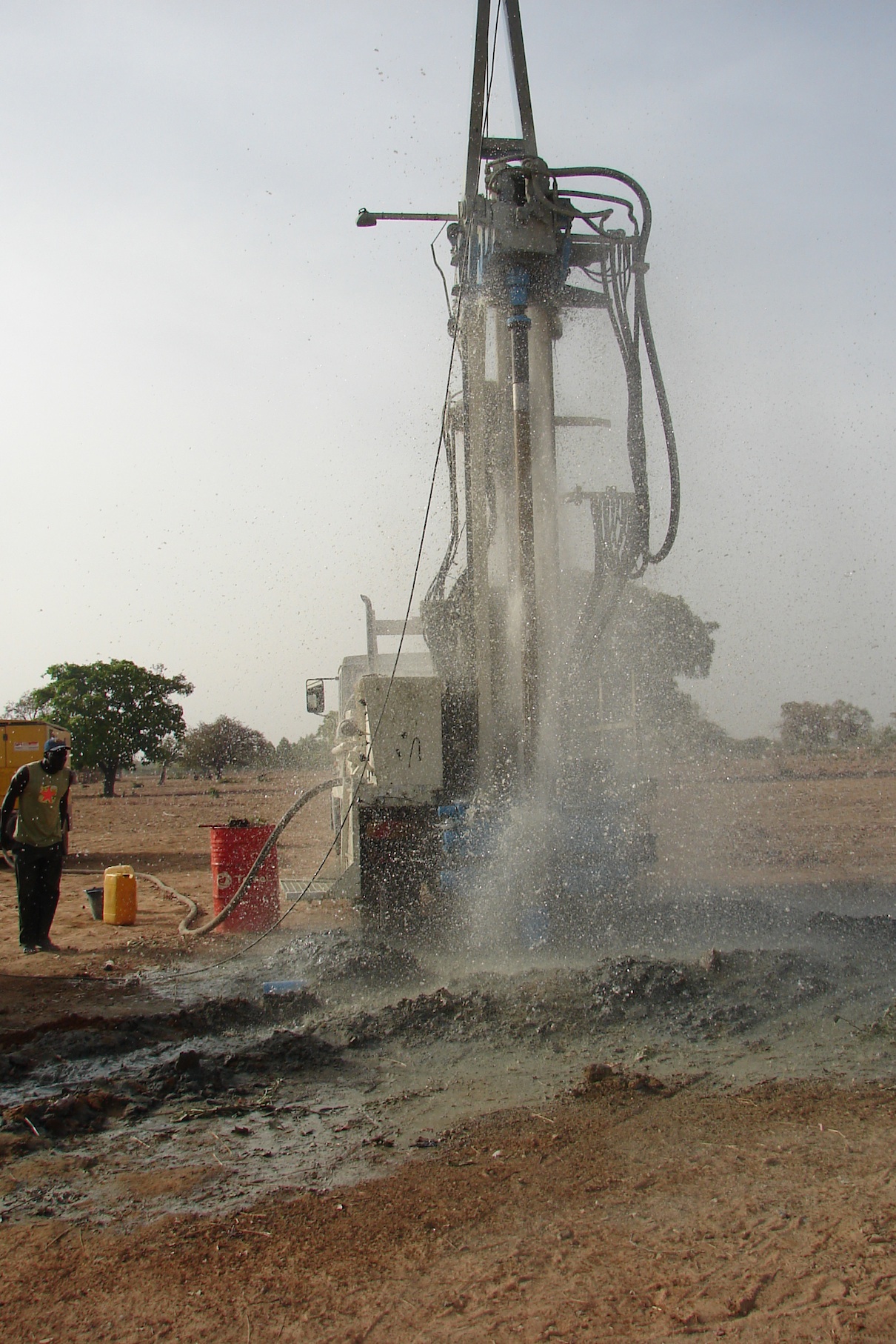
And of course we are in good company with a small crowd of very interested adults and curious children.
The measured yield is good (over 1.80 cu m/h), and according to Barnabé it will come closer to 2.00 on a more precise measurement, once the inevitable ground losses under the current measurement conditions are accounted for. The water will quench the thirst of a dispersed population of around 450 people, part of a much more extensive urban cluster served today by at least two or three other scattered wells, the nearest of which is for the exclusive use of the school under construction about 700-800 metres away. And there is good scope for a vegetable garden around here too…
It is lunchtime. Barnabé has an engagement at nine; he leaves us with his friend Marcel who very kindly takes us back to the sisters.
Before lunch we would have time for a quick trip to Koupela’s market (we have been saying “let’s go” since Sunday). But the heat and tiredness overcome our good intentions: we end up downloading footage and photos and updating this report for our readers, who we believe (so Simona says…) are interested.
In the afternoon we have an appointment with Barnabé to take stock of the situation and do an update of the financial balance for the completed wells. We take advantage of his availability to send the update of our efforts by email. Lucien joins us too, and together we agree on a …little intimate dinner for tomorrow evening. Before we part, Barnabé thrills us with the news we had hoped for: Filippo’s plaque is ready! He shows it to us proudly; tomorrow we will go together to put it up with the village inhabitants. After dinner, the now customary visit to Marisa and Gualtiero’s, for a little respite (with the air conditioning), a beer, and pleasant conversation.
Day 8 (Saturday the 19th)
7:30. Quick breakfast and off in the car, jam-on-mango sandwich still in hand.
The route is now well known. We take the opportunity for an interesting and illuminating exchange of views with our guide, Abbé Barnabé, on the criteria for identifying localities where it may be appropriate to build wells, with a checklist of requirements to verify. We think it appropriate to add this to the agenda for the next members’ meeting… Along the road we stop to buy a small tin of yellow paint. Paint because — having spoken with Stefano by telephone yesterday — we agreed on the appropriateness of adding Filippo’s name to the plaque that reproduces his drawing; yellow because …it is the only colour Barnabé could find!
And the brush? There are plenty of twigs out in the bush… We recognise the well from a distance. Although the wheel is turning, there seems to be few people.
But it is only the sun: upon our arrival, as always happens, figures materialise as if by magic from every direction, having until now been seeking shelter behind bushes, under makeshift or improvised shade, under the flowing canopy of majestic mango trees, inside dark circular huts of straw and mud. And among them of course children, many children.
Barnabé has given notice of our arrival this time, so the village chief welcomes us with a big smile and with the tools of the trade already in hand: we have the nails, he brings the …“hammer”. Rita positions the plaque, Abbé Barnabé marks the points, and Massimo drives in the four nails with the “hammer” (a sort of reversed hoe whose round eye simply will not let the nail go in straight). Then, with the tip of a fifth nail dipped in yellow paint, we experience a strong emotion writing the name on the white border at the bottom: “Filippo”. Rita films the scene. The audience watches, observes, approves.
In the shade of a thorny tree they seat us on a bench beside the “wise men” and the elders; opposite us the village chief, seated next to the one we take to be his wife, on deckchairs made of woven sticks lashed together with leather cordage (goat hide, we assume). Behind them, the frame of the village’s inhabitants: women in festival clothes and headgear in bright, vivid colours, and dusty children sitting on laps or folded double inside the pareo tied across their mothers’ backs, some busily suckling with perfect naturalness from breasts grown too elongated and slack. The older ones giggle, sitting side by side in the ever-present yellow dust.
When Abbé Barnabé introduces us and explains to the audience the reason for the plaque, attention reaches its peak and a few heads nod quietly.
The village spokesman gives thanks and, with Barnabé’s simultaneous translation, explains to us how the presence of the well has strongly influenced the ordinary management of their lives, opening new prospects for the very life of the village: no more interminable and exhausting back-and-forth simply to satisfy primary needs. Now the availability of clean drinking water awakens new desires: they would like to create a vegetable garden and ask us to finance the cost of fencing it (indispensable against raids by domestic animals!). Barnabé approves — the request is legitimate — but they will first have to demonstrate their personal commitment to the proper management of the new resource…
Then songs in our honour (and in teasing of our “joking relative” Barnabé…), dances to the rhythm of improvised drums, dust raised by the bare feet of younger and older women swaying and taking turns in pairs inside the circle of clapping hands to the beat of the traditional dances. Rita is tempted, you can tell… but this time she resists. A shame…
[n.d.S. I am also still editing the video here… I must say the footage is wonderful — women improvising music and dances of thanksgiving. Magnificent.]
We try to document everything as best we can, as asked of us. Handing out the sweets this time has a sweeter taste; they are Filippo’s “bon-bons” for that multitude of small friends of another colour and from a world far away that he would certainly have liked to know, but who now know him. The road home flows familiar and therefore fast. At Mogtedo we do not find Abbé Jacob, who is out doing his Lenten rounds; we leave at the parish the two Below 2011 calendars we had forgotten to bring him a few days earlier. Then a detour on now-familiar dirt tracks to photograph a well Barnabé has built for others and which needed documenting. We return once more via Puitenga, past which we rejoin the “motorway” that takes us back to Koupela, in perfect time for the 12:30 lunch with the sisters.
You won’t believe it, but the rest is finally leisure! Two hours of rest, a shower, and then Gualtiero proudly takes us to visit “his” hospital, “his” equipment, “his” small and large patients whom he tends with such love and dedication up to the point this reality makes possible. We know the possessive “his” doesn’t quite capture it, that it probably doesn’t suit the person; but we mean it in a positive sense, acknowledging in him the paternity and soul of that wonderful thing he has managed to create, called “Ospedali in Burkina.” We might say — perhaps boldly — that Gualtiero stands in relation to “Ospedali in Burkina” roughly as our “dear President” stands in relation to “12 Scatti.”
We still have a little time; so off with Marisa into the narrow passageways of Koupela’s market. Strong colours and smells, a moment of queasiness in front of the open-air “butchers,” people everywhere. Someone strikes a pose to be photographed; someone else gets annoyed if you point the lens at them: it is always better to ask first… We spend thousands (!) of CFA francs on small pieces of Africa to bring back home. Between people’s legs, the local “sweepers” (those who have already read will know…) are always at their work with dedication.
7 p.m.; Barnabé’s Toyota appears punctually. We head to the “refreshment point” (we wouldn’t know what else to call it), not before picking up Lucien who has come all the way from Baskurè especially for us. We are lucky enough to run into Alexis, whom we greet with genuine pleasure. We sit outside, on the street, in the dark, two metal tables pushed together and four chairs: just enough to share a typical local dinner in pleasant company, washed down with a good cold beer, …a whole one each…
Day 9 (Sunday the 20th) – The return
It is Sunday. The two previous nights it seemed we had slept a little better. Tonight the heat came back… Around two thirty in the morning we both find ourselves, somewhat dishevelled, seeking a breath of cool air seated on the open porch, under a veiled full moon. At six, resigned, we are already up doing the chores of the last day and packing.
It is already Sunday. The next one… The time has already run out.
We are torn between the hope of finally finding a little rest in Rome and the desire to extend this renewed and moving experience indefinitely. Those who were here before understand… Before leaving, however, one last effort: the ceremony of perpetual vows renewal of Sister “Ididn’tcatchthename.” At nine, under a blazing sun, with Marisa and Gualtiero we arrive punctually at the Cathedral, where everything is ready for the ceremony. The service is colourful and lively, but interminable! Only at around one o’clock do we find ourselves in the hall set up as a refectory, where the sisters bring in all the abundance they have been feverishly preparing since yesterday for the occasion. We recognise even the chickens Rita received as gifts: they have taken on a fine colour…
There is a crowd! People we consider important, from the Bishop to all the local prelates, from sisters of the entire district and all congregations to the Nabà of Antemtenga with his daughter; there is even an improbable son of Al Capone — a child of about ten dressed in a preposterously oversized outfit of some kind of shiny satin, complete with waistcoat and tie. Disarmingly serious, he comes to pay his respects, extending a small child’s hand with the manner of a grown man… on the jacket cuff the tailor’s label proudly displays itself… Impressive!
At last it ends… We are a little tired. We gladly accept the invitation for coffee at the home of …well, you know who by now. The parting from our friends Marisa and Gualtiero is very difficult, but the time has now run out. Just time to close the bags and punctual as a …Marcel — here comes Marcel. We load the bags onto the Toyota’s flatbed, a kiss — no, four (two per cheek, as is customary here) — to all the sisters we manage to find, and then… departure for Ouaga.
Along the road we find ourselves thinking that already tomorrow we will miss these places. And, as Rita rightly says, not only tomorrow… At Koupela we pick up Lucien who refused to let us leave without accompanying us; we are very grateful for that. In the car, conversations between old friends, weaving between two or three improbable languages. In Ouaga a quick detour to the Artists’ Village (we must come back, but with more time available), then a rush to the airport. We’ll spare you the sadness of the farewells, the effort of check-in, and the difficulties at the numerous checkpoints through to boarding… Now we are here, a little subdued, jotting down the last lines of what was supposed to be only a dry technical data report, but which we realise has gradually taken hold of us more and more. Evidently we are not yet quite such “veterans” after all…
If we can manage it, we’ll try to sleep a little. And tomorrow …it starts all over again.
End of transmission.
Rita and Massimo