As last year, my mother and her partner went to Burkina Faso to visit the current state of the wells built together with the association 12 Scatti per l’Africa, which I have already told you about in this post.
I have to admit I regret not having thought earlier to explain to her how Twitter works, so she could tell the story live as she was experiencing it. So I decided to do it for her.
I relay on Twitter what she tells me via text message :) in real time: the moment she writes to me I write to you, because I like the idea of making you part of this, of giving you a real firsthand account from the field :) I decided to use the hashtag #12scatti as it recalls the name of our association.
Life in the villages of Burkina Faso is not easy at all; my mother and her partner (last year they were four, this year just the two of them) are staying at the nuns’ establishment, which also has a hospital and an internet connection through which my mother managed to send me the travel diary of the first few days and a photo!
I decided to post the travel diary, written jointly, just as it is in its entirety :) with the typos, the perhaps misspelled village names, and the table of wells to visit; complete with Massimo’s irony and my mother Rita’s sensitivity :)
Here and there you will find small notes written by me, simply to explain what is being mentioned :)
But enough talk, here is the diary :)
BURKINA FASO 2011
(Massimo and Rita)
Here we are, travelling again…
We are "veterans" now, we know what awaits us.
And yet it is always a great emotion.
Day 1 (Saturday the 12th) – The journey
Fiumicino. This time experience has served us: we checked the luggage at home. Two bags each, maximum weight 23kg each …checked in advance at home. We only hope they won’t arrest us for …drug trafficking in medicines!
We arrive at around 21:15 in Ouagadougou, only one hour late. Inevitably and punctually …one bag is missing! Thank goodness it’s not one of those with clothes… But there are the sweets, and a great many medicines. The usual formalities for the complaint (this time in a run-down but real office, with air conditioning no less!), they are kind, they apologise for the inconvenience… they will send it directly to Koupela over the next few days.
Abbé Lucien is waiting for us, with Marcel acting as driver. It has got late; we stop to eat chicken with chips and have a beer. Rita can barely stay awake (thank goodness, because I can hardly admit that I’m exhausted too…). 120 km later, at around 2:30, Sister Noelì opens the gate of the Koupela mission for us… By 3:00 we are finally in bed!
Tomorrow is Sunday. Rita would like to attend the service… at 6:30… I doubt it…
Day 2 (Sunday the 13th)
A night spent tossing and turning on sheets soaked with sweat, half-asleep. I wake with a start. Someone has sat down on my bed. It is 7:30…
- Rita, what are you doing up at this hour…
- I couldn’t sleep; and anyway I was already awake and got up…
Right… and now I’m awake too…!
This morning we have an appointment with Abbé Barnabé to set out the programme for the coming days. Before 10:00 we have time for a coffee and to record the coordinates of the new mission well, which is located …in the chicken coop! It doesn’t have the usual look, with the now-familiar Volanta wheel. It is a square manhole cover in the ground, protected by a metal hatch, and sends water to the storage tanks via an electric pump installation.
Just time to document it with Rita’s (NEW!) camera, and here is Barnabé. Drawing up the programme is no simple or quick matter. We had to synchronise the available data on the wells already completed, those to be inspected and those requested.
Some of the wells drilled with the advance drilling cost have unfortunately come back negative. We would like to include these in the visiting schedule too. The programme that emerges from all this looks decidedly demanding. Our previous travel companions do not need to be reminded what it means, in these parts, to visit on average four, and even five villages in a single day, each perhaps only a few dozen kilometres apart, but so many hours off-road!
Still, we are far from wanting to complain: we are privileged after all! For the more “technical” or more curious among you (and above all for our “dear president”), we attach the details…
[n.d.S. I’m not sure the table comes through clearly — it is an image taken from the document they sent me]
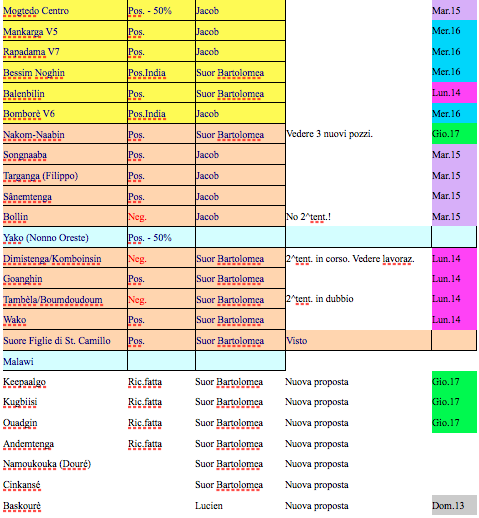
And for the usual sceptics, we haven’t forgotten Friday and Saturday… we’ve simply left them as wild cards (Barnabé says we’ll hardly stick to the programme… but we came here precisely for this, and we’ll give it everything we’ve got!). At lunch we have a chance to greet the sisters who are hosting us with such grace and courtesy. Sadly Sister Bartolomea is not here…
They ask after Stefano one and Stefano two, they want news, we pass on everyone’s greetings. At four in the afternoon we have an appointment with Julien to go and visit the Seminary of Baskourè, where he has now been posted as teacher-administrator for a year. He has asked us to build a well for the young seminarians’ community.
He arrives in a sort of yellow “Van” — partly because it was painted that way, partly from the siliceous sand dust that covers more or less everything, and which before long will cover our clothes too. In barely half an hour we cover the roughly 15 kilometres from Koupela to Baskourè and enter the seminary grounds.
Dozens upon dozens of young men (from 12 up to over 20 years old, as we will discover) are busy playing every kind of sport, raising clouds of reddish dust. Julien acts as our proud guide, showing us the various study, rest, and recreation spaces that these “fortunate” young men have at their disposal. He dwells in particular on the garden-kitchen plot, for whose cultivation he needs greater quantities of water. Our doubt is: but is this really a priority?
We will certainly discuss this with the association’s members. In the meantime we are forming our own thoughts on the matter… This centre has more than 140 young men. It is a training centre for priests, even if only around 10% of them will actually become one. But it is above all a centre of cultural, spiritual, and life formation, which even those who abandon their vocation will certainly draw on. And in all this misery surrounding us, is this not also, in its own way, an investment in the country’s future?
When we head back towards the offices, the outdoor showers are crowded with noisy young men who smile at us with curious amusement. A few photos, handshakes, free and disarming smiles dispensed generously… Then a good — no, two good glasses — no, I would definitively say three good bottles of draught beer (goodness, how much they drink around here!), then straight back to Koupela: remember? Our sisters do not tolerate lateness at mealtimes…
Day 3 (Monday the 14th)
Seven o’clock, breakfast, punctual as good manners demand. We are veterans now… We don’t get emotional so easily anymore. So in our reports we will be precise, to the point, professional. At 7:30 Marcel (the driver) arrives on time and takes us to the OCADES offices to pick up Alexis (the “non-satellite navigator” — you cannot imagine how useful he will prove!).
You know the programme: in order we will visit:
- Goanghin
- Balembilin
- Wako
- Tambela/Boumdoudoum
- Dimistenga/Komboisin
Goanghin
We barely have time to settle in the car before we’ve arrived… So where is the difficulty in the programme? The well is right in front of a single-family homestead with …25 people! Similar homesteads all around. The water flows steadily, driven by the Volanta pump.
With professional composure, we go to record the position, and then…
…And then there they are! Again, they pop up from everywhere, laughing, cackling, surrounding us.
Beautiful and dirty beyond all measure. How could it be otherwise with this dust! Where are the sweets? Curse you, Air France! A brief visit to the nearest homestead (lovely in its simplicity: in one corner, pots over a fire where beer is being prepared), a few photos, some posed. Then off: there is still much to do.
Balembilin
The transfer starts to get longer. The village is made up of family homesteads spread fairly far apart. In all, some 300 people now have the possibility of quenching their thirst and refreshing themselves with water from our well!
But not only that: two vegetable plots on either side of the well show us with pride their green produce. And then? Well, we are professional and detached, don’t you remember? So we won’t mention the children, the celebrations, the requests for posed photos so they can see themselves and laugh with quiet delight…
Rita’s new camera could not have a better trial by fire: by the end of this first day it will have taken more than 200 photos!
But at a certain point she has to hand the digital Canon to me: otherwise she would not be able to receive — to her very great delight (you should see her face…) — the two chickens that the village chief, holding them by the feet, offers her as a token of thanks. Stefano 1 and Stefano 2, you know: it is dangerous to refuse!
Wako
We are beginning to sense that there really are some difficulties… Will we ever reach this village?
Even the “non-satellite navigator” seems unsettled at certain crossroads (if one can call the fork of two dusty paths through the savannah scrub by that name). Sister Bartolomea points out the different shapes. There is the Sleeping Elephant and the Duce’s Hat, (the Finally we arrive. After just under an hour, to discover we are at the remarkable distance of …12 kilometres from Koupela!
Not many people to welcome us. This year Barnabé decided it was more honest not to warn the villages of our arrival, so we can see the reality unfiltered by the preparations for a welcome. The village is decidedly large, though it is impossible to make out all the dwellings, scattered very far from one another. Alexis, translating the locals’ reply, tells us that around 5,000 souls live here.
That seems a little excessive to us (or perhaps we misunderstood); but I would say the well fits in well here. It is not yet complete: for now there is only the blue pipe protruding about a metre from the ground, protected by brushwood propped around it. Soon the containment structure will be built and the Volanta pump wheel fitted, to the joy of the village’s inhabitants.
So, on to the next village.
Tambela/Boundoudoum
If the first seemed far away …this one seems completely unreachable! For the first stretch a boy on a bicycle escorts us, pedalling along the narrow path ahead of our four-wheel drive, pointing the way for a while until we reach the …main road. From here, carry on alone, always straight ahead.
Too bad we couldn’t tell the difference between this road and the path we were on before! After hesitations, setbacks, requests for directions (help! Where are we?), our “non-satellite navigator” brings us to our destination. Unfortunately this is one of the wells that came back negative, in an area with no other water sources within over six kilometres, serving a population of more than 400 souls! And the hope of attempting a second drilling seems remote. The village representative is overjoyed at our intention to speak with Barnabé about a possible second attempt…
They are grateful, even though the well came up dry. And this comes at a cost to Rita …who finds herself holding the tied legs of the third chicken of the day!
There is no need to describe yet another immersion in a sea of children (because we are veterans by now…); in this regard Alexis points out that those fifteen or so curious children surrounding us to get their photos taken are all children of the village chief.
On the way back, we unfortunately receive the news that today our circuit ends here: the second attempt at Dimistenga also failed… The return to Koupela is a little subdued for that reason. We nonetheless take the chance to make a brief stop at the market, to buy bread for the mission and to plunge once more into the local colour.
After lunch (and a well-earned rest), we take advantage of the free afternoon to visit the hospital and take a short walk (in blazing sun) to the giant Baobab and the well at Pousga, which continues to do its job brilliantly, under the efforts of young women who continuously fill the famous yellow jerry cans. [n.d.S. the yellow jerry cans are used to carry water back to the village]
Before dinner a pleasant interlude: a visit to an old friend (met only once, two years ago) who has remained in our hearts: Gualtiero, with his faithful companion Marisa, has been working since November for the good of the Burkinabe people at the sisters’ dispensary.
[n.d.S. I too thank Gualtiero, who made it possible for my mother to email me :) ]
We find him tired, but still as determined as we have always known him.
Day 4 (Tuesday the 15th)
Seven o’clock, breakfast.
Well-rested? How could one be, after a night of tossing and turning on damp sheets, moving in desperate and futile search of a patch of cool bed — the sheets are warm! Punctually at 7:30 Marcel arrives with the four-wheel drive (we’ve had a good look at it: it’s a Toyota Hi…); together we go to pick up Alexis at the OCADES offices and set off on the day’s programme. But first a stop to buy some sweets. Ours are still in the missing luggage, which has not yet rematerialised… but you cannot turn up in front of the smiling faces of Burkinabe children without at least a “bon-bon”, as they call them.
In order, we will visit the wells of:
- Mogtedo Centro (near the school)
- Bollin (a well that unfortunately came up negative)
- Targanga (Filippo's Well)
- Sanemtenga
- Songnaaba
Mogtedo Centro
The well is right where it ought to be: in front of the crucifix, beside the school entrance. It is functioning, the water flows copiously under the Volanta pump’s pressure. A shudder when a haunting presence approaches pushing a wheelbarrow with jerry cans to fill up with water. I wonder how the Muslim women behind that black veil from head to toe feel and what they think — you cannot even make out how they manage to see. I cannot spot any opening at all…
After handing out the sweets (which this time we have brought), we have time for a greeting with Abbé Jacob, who asks particularly after Stefano. Reassured by our answers, he informs us that the school has around 110 pupils today. I would say that is a good result!
But the day is long and tiring, so we depart for…
Bollin
Having left the “motorway” (!!), we turn left into terrain that becomes progressively more barren and arid. Granite outcrops and small rocky hills accompany us along the route, seasoned with the inevitable clouds of yellow-reddish dust raised by the car. The path is rough and rugged, difficult to identify beyond the main tracks.
We start to despair when, after over an hour of driving, even our “non-satellite navigator” feels the need to stop and ask… a boy on a motorbike… a woman on a bicycle (who points us in the exact opposite direction!)… the amazed inhabitants of an isolated cluster of houses.
From here, finally taking pity on us, a “non.sat.navigator.on.wheels” escorts us to a new isolated cluster (the path is so narrow that the four-wheel drive’s tyres ride on the rocks marking its edge); here we swap “non.sat.navigator.on.wheels” to be finally escorted to our destination.
And here one cannot help asking: all this effort, for what? On the ground, at the spot where the drill bit sank its probe, a sad mound of grey crushed rock, evidence of the unfortunate negative result of the drilling. We feel very sad thinking that this community of around 70 people will have to continue to forgo the dream of a clean water supply of their own, and to keep making the long journey back and forth to the nearest well more than five kilometres away across the savannah…
Targanga
Here we will keep it brief and take you straight to the destination, but I assure you the treasure hunt was equally exhausting!
The prize, however, is the sight of a perfectly functioning and fully active well. Even from a distance, in this barren and flat landscape, you can make out the unmistakable outline of the Volanta. Alexis tells us that the water is not extremely plentiful, but we can see it flowing nonetheless in sufficient quantities under the effort of a young woman working the wheel. This is Filippo’s well. I think he could not have chosen a more remote and needy place in which to carry out his act of generosity.
Filippo’s well is the only one in this area; it will give a prospect of relief, hope, and life to a community of over 700 souls, including the children — many of them, dirty, but beautiful! I think we can consider ourselves satisfied; …that Filippo’s mother can be happy; …that Filippo certainly will be.
Sanemtenga
This time the route is shorter, and in about a quarter of an hour brings us to our destination. The morphology of the area is always the same: we think these are among the most arid places we have visited so far.
The well is fortunately perfectly functional, the water flows in abundance (by no means guaranteed in these parts!), the pump is the usual Volanta. It will certainly be of great support to the roughly 400 people who populate this remote village. All the more so given the more than five kilometres that separate them from the nearest well!
Before departing, the usual immersion in a sea of children. But this time we are equipped, and can hand out sweets to each of the outstretched little hands. To Rita’s delight… the village chief extends her the usual two tied chicken legs as a token of thanks (and Rita now knows you cannot refuse to accept, so she makes the sacrifice. On our return to Rome I shall propose an official recognition and a citation of merit for her).
Songnaaba
To reach Songnaaba it is necessary to retrace the long route all the way back to Mogtedo, just past which you take a dirt track to the left that soon becomes the usual rough, rutted path. The village is situated in what seems a more densely populated area compared to the one we are coming from, not an excessive distance from the town. There do not appear to be any other wells close by.
Upon our arrival the Volanta is stationary, but on the surrounding bushes a multitude of brightly coloured clothes laid out to dry in the sun shows that until shortly before, the well must have been very busy supporting the young women of the village in their daily activities! As always upon our arrival (which, as you will recall, this time was not communicated in advance to the communities concerned), a small curious crowd approaches, with the usual retinue of shy and respectful children, yet immediately ready to join in with enthusiasm and amusement in the usual ritual of “take a photo of me and show it to me”, followed by sweet distribution…
Technical information: the well is positive and the only one within a three-kilometre radius, is equipped with a Volanta pump, and serves a community of around 500 people… whose “chief” makes a play for Rita and she takes the opportunity to be immortalised together with him in a heartfelt hand-in-hand photograph.
The return to Koupela is preceded by a well-earned stop for a cold beer and a snack at the “brewery” in Mogtedo, in the company of our friends Alexis and Marcel.
[end of diary for now]
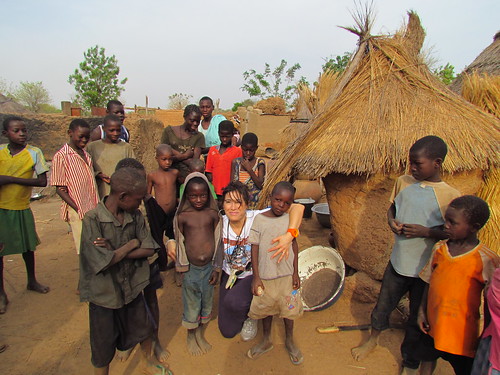
That is everything for now; I am waiting for news from Mum, whom I unfortunately have not heard from today yet, and for the diary of the coming days :) I leave you with the photo she sent me: the one in the middle is her with the children of a nearby village :)